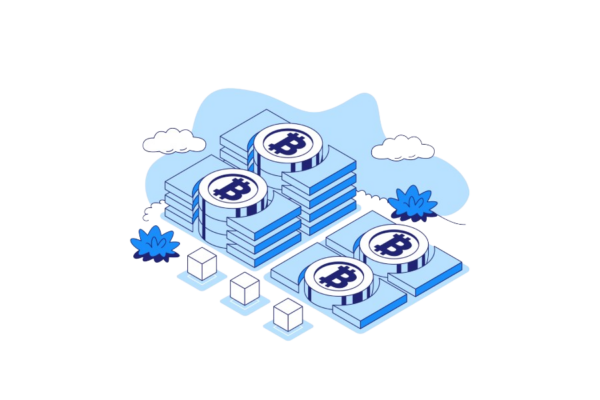
A Bitcoin ATM is a machine that sells bitcoin for cash and sends it to a wallet address you scan. Two-way machines also buy bitcoin for cash. Set up your own wallet first, check the fee and exchange rate on the screen, and never scan a QR code from someone else, because scammers use these machines heavily.

A Bitcoin ATM, also called a crypto kiosk, lets you buy bitcoin with cash at a machine in a shop or a gas station. This guide shows how to use one, what it really costs, how to spot the scams around these machines and where they are restricted. If you are new to buying crypto, the beginner’s guide to buying crypto compares every way to buy.
You need a wallet of your own before you start, because the machine sends the coins straight to it. If you would rather not use cash, you can also buy bitcoin online and have it sent to your own wallet.
How does a Bitcoin ATM work?
A Bitcoin ATM is a machine that sells you bitcoin for cash and sends it to a wallet address you give it. Unlike a bank’s cash machine, it is not linked to your bank account, and it does not keep your coins for you.
Most machines are run by private companies called operators. According to a 2023 analysis by a California State Assembly committee, the operator usually sells crypto from its own supply and earns money from fees and from charging more than the market price. Nearly all use is buying: in Australia, the financial intelligence agency AUSTRAC found that about 99% of crypto ATM transactions were cash deposits to buy crypto (as of June 2025).
There are two kinds of machine:
- One-way machines only sell bitcoin to you.
- Two-way machines also buy bitcoin from you and pay out cash.
Many machines also offer other coins, and some take debit cards as well as cash.
How do I buy bitcoin at a Bitcoin ATM?
Set up your own wallet, find a machine, check the price, verify your details, scan your own wallet’s QR code, then insert cash and keep the receipt. Here are the steps in order:
- Set up your own wallet. Install a wallet you control and write its recovery phrase down offline. If this is your first one, read what a crypto wallet is.
- Find a machine. Use the operator’s website or an independent map such as Coin ATM Radar. Check that the machine sells bitcoin and that crypto ATMs are allowed where you live (see the table below).
- Check the price before you pay. The screen or a sticker on the machine shows the operator’s fee and its bitcoin price. Compare that price with a live market price on your phone.
- Verify your details. Many machines ask for a phone number and text you a code, and ask for photo ID or a selfie for larger amounts.
- Scan your wallet’s QR code. Open your wallet, choose Receive and hold the QR code up to the scanner. Only scan an address from your own wallet, never a QR code that someone sent you.
- Insert cash and confirm. Feed in your notes, check the amount of bitcoin and the fee on the screen, then confirm. A bitcoin payment cannot be reversed once it is sent.
- Keep the receipt. It records the amount, the fee and the operator’s contact details. The bitcoin shows up in your wallet once the network confirms the transaction.
For the other ways to buy, step by step, see how to buy bitcoin.
How do I sell bitcoin at a Bitcoin ATM?
You need a two-way machine that buys bitcoin. You send bitcoin from your wallet to an address the machine shows you, and it pays out cash once it has received the coins.
- Check that the machine buys bitcoin. Not every machine does.
- Choose Sell and enter the amount. The screen shows the rate and the fee.
- Verify your details. Expect the same phone and ID checks as for buying.
- Send the bitcoin. The machine shows a QR code with its address. Scan it with your wallet and send the exact amount shown.
- Collect your cash. Some machines pay out as soon as they see your payment. Others print a code or receipt so that you can collect the cash later, once the network has confirmed the payment.
The operator sets both the rate it pays and its fee, so compare them with the market price before you send anything. For other ways to cash out, such as selling to your bank account, see how to sell bitcoin.
How much do Bitcoin ATMs charge?
Bitcoin ATMs usually charge a fee plus a markup on the price. The markup, or spread, is the gap between the operator’s price and the market price, so the total cost is often higher than the fee on the sticker.
Costs can be high. A July 2023 analysis by the California State Assembly’s banking committee cited kiosk fees of 7% to 20% per transaction, and said that industry stakeholders put them as high as 30%. In the UK, the Financial Conduct Authority (FCA) said that a man it prosecuted for running illegal crypto ATMs typically charged a markup of 30% to 60% on each transaction.
Some laws now cap what operators can charge. In California, since 1 January 2025, an operator cannot collect more than $5 or 15% of the transaction, whichever is greater (as of September 2026).
Before you pay, check each part of the cost:
- The operator’s fee: a percentage, a flat amount or both.
- The spread: built into the machine’s bitcoin price rather than shown as a fee.
- The network fee: the cost of sending bitcoin on the blockchain, which some operators add on top.
A quick check: divide the cash you put in by the amount of bitcoin you get, and compare the result with the live market price. The difference is what the machine really costs you.
Are Bitcoin ATMs safe?
The machines themselves usually work as described, but they are heavily used in scams. Criminals tell victims to withdraw cash and deposit it into a Bitcoin ATM, and once the bitcoin is sent, the money is almost impossible to get back.
The FBI’s Internet Crime Complaint Center (IC3) received 10,956 complaints involving crypto ATMs or kiosks in 2024, with $246.7 million in reported losses. In 2025, complaints rose to 13,460 and losses to $389 million. The IC3 notes that some of these complaints also involve other kinds of payment. Older people are hit hardest: the US Federal Trade Commission (FTC) found that people aged 60 and over were more than three times as likely as younger adults to report a loss at a Bitcoin ATM, and the median reported loss in the first half of 2024 was $10,000 (all as of September 2026).
For your physical safety, use machines in busy, well-lit places and do not carry more cash than you need.
What are the warning signs of a Bitcoin ATM scam?
- Someone tells you to deposit cash. A caller, message or pop-up tells you to take out cash and put it into a Bitcoin ATM, often while staying on the phone with you.
- Someone sends you a QR code. A QR code from a stranger sends your money straight to the scammer’s wallet.
- “Your bank or the government asked you to.” Scammers pose as your bank, the police, a government agency or a tech company. The FTC says real businesses and government agencies will never tell you to use a Bitcoin ATM.
- A new online contact asks for crypto. Someone you met online asks you to buy crypto for them or promises big returns. See investment scams.
- You are told to keep it secret. Anyone who tells you to lie to your bank about why you need the cash is a scammer.
If the machine or its operator warns you that a payment looks like fraud, stop. The IC3 advises you to stop the transaction straight away.
What should I do if I have been scammed?
Stop sending money, contact the ATM operator and report the scam as quickly as you can.
- Call the operator on the number shown on the machine or the receipt, and keep every receipt.
- In the US, report it to the FBI at ic3.gov and to your local police.
- In England, Wales and Northern Ireland, report it to Report Fraud, which replaced Action Fraud in December 2025. In Scotland, report it to Police Scotland.
- In Australia, report it to ReportCyber and Scamwatch.
- Ignore anyone who offers to recover your money for a fee. That is often a second scam.
For more ways to stay safe, read how to protect yourself from fraud and common scams in the crypto industry.
Are Bitcoin ATMs legal where I live?
It depends on where you live: some places ban them, and many cap how much you can put in. These are some of the main rules as of September 2026:
| Place | Rule | Since |
|---|---|---|
| Indiana, US | Crypto ATMs are banned | Law signed 9 March 2026 |
| Wisconsin, US | Limit of $1,000 per user per day; operators must refund scam victims who report to the police and the operator within 30 days | Law signed 8 April 2026 |
| California, US | Limit of $1,000 per customer per day; charges capped at $5 or 15% of the transaction, whichever is greater | Limit since 2024, cap since 2025 |
| United Kingdom | Running a crypto ATM without FCA permission is illegal; a man who ran illegal machines was jailed for 4 years | First sentence 28 February 2025 |
| Australia | A$5,000 limit on cash deposits and withdrawals, plus mandatory scam warnings | June 2025 |
| New Zealand | A planned ban was dropped; the government is taking powers to limit cash transactions instead | July 2026 |
Across the US, AARP counts 35 states that have passed laws on crypto kiosks since 2023, 18 of them in 2026, and says four states besides Indiana have adopted laws to eliminate or nearly eliminate the machines. In the UK, the FCA reported that the number of UK crypto ATMs listed on Coin ATM Radar fell from more than 80 in 2022 to none in 2024. Rules change quickly, so check with your state or national authorities before you use a machine.
Bitcoin ATM or buying online: which is better for beginners?
It depends on how you want to pay. A Bitcoin ATM suits people who want to pay cash; buying online suits people who pay by card or bank transfer. Either way, have the coins sent to a wallet you control.
| Feature | Bitcoin ATM | Buying online |
|---|---|---|
| How you pay | Cash, and sometimes a debit card | Card, bank transfer or other methods, depending on the service and your country |
| Identity checks | Often a phone number, and photo ID for larger amounts | Usually an identity check before you buy |
| Limits | Set by the operator, and by law in some places | Set by the service |
| Cost | The operator’s fee plus the spread in its price | Fees and the spread differ by service; check the total before you confirm |
| Where the coins go | The address you scan | The address you enter, or an account with the service |
| Main scam risk | Victims are told to deposit cash at a machine | Phishing sites and fake support accounts |
Either way, compare the total cost, not only the headline fee, and never buy because someone else told you to. To move coins safely, see how to send bitcoin to a wallet. To decide where to keep them, compare a hot wallet vs a cold wallet.
Frequently asked questions
Sources
- FBI Internet Crime Complaint Center: 2024 IC3 Annual Report (checked September 2026)
- FBI Internet Crime Complaint Center: 2025 IC3 Annual Report (checked September 2026)
- FBI Internet Crime Complaint Center: Cryptocurrency Kiosk Complaint Data by State (15 May 2026) (checked September 2026)
- US Federal Trade Commission: Bitcoin ATMs: A payment portal for scammers (3 September 2024) (checked September 2026)
- Financial Conduct Authority: Olumide Osunkoya sentenced to 4 years for illegally operating crypto ATM network (28 February 2025) (checked September 2026)
- National Law Review: Indiana Law Prohibits Virtual Currency Kiosks (House Bill 1116) (checked September 2026)
- Indiana Senate Republicans: Legislation banning cryptocurrency kiosks ceremonially signed by governor (30 April 2026) (checked September 2026)
- AARP Wisconsin: New crypto kiosk law stops criminals in their tracks (16 April 2026) (checked September 2026)
- California Financial Code section 3902 (daily limit) (checked September 2026)
- California Financial Code section 3904 (charge cap) (checked September 2026)
- California State Assembly Committee on Banking and Finance: SB 401 analysis (hearing of 10 July 2023) (checked September 2026)
- AARP: How states are taking aim at crypto ATM fraud (updated 14 September 2026) (checked September 2026)
- AUSTRAC: Scams, fraud and other illicit activity: AUSTRAC puts crypto ATM operators on notice (3 June 2025) (checked September 2026)
- AUSTRAC: Scams involving cryptocurrency ATMs (checked September 2026)
- New Zealand Government: Crypto ATMs to get guardrails, not the guillotine (9 July 2026) (checked September 2026)
- City of London Police: Report Fraud service goes live (December 2025) (checked September 2026)